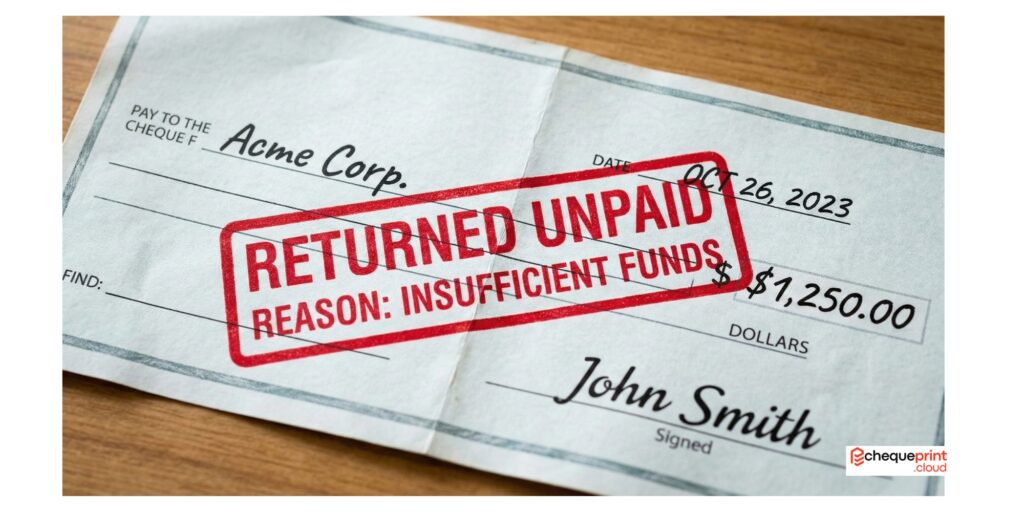
There are few things more frustrating than receiving a notification from your bank that a cheque you issued has “bounced” (returned unpaid). Not only is it embarrassing, but it can also be expensive. Banks often charge hefty “Non-Sufficient Funds” (NSF) fees, and in many jurisdictions, a cheque bounced can lead to legal complications.
While most people think cheques only bounce due to a lack of money, roughly 30% of cheque rejections happen due to technical errors—bad handwriting, spelling mistakes, or date confusion.
In this guide, we will explore the top reasons cheques bounce and how using a digital printing tool can save you from these costly mistakes.
1. Insufficient Funds (The #1 Culprit)
The most obvious reason is simply not having enough money in the account. When the payee presents the cheque to their bank, the clearinghouse checks your balance. If the funds aren’t there, the cheque returns.
How to Avoid:
- Keep a buffer amount in your checking account.
- Use “Post-Dated Cheques” (PDC) if you know funds will arrive later. However, ensure you clearly communicate the date to the payee so they don’t deposit it too early.
2. Signature Mismatch
This is a surprisingly common issue, especially for accounts that have been open for years. Your signature today might look very different from the one you signed on the bank opening form 10 years ago.
If the bank clerk feels the signature differs significantly, they will return the cheque with the memo “Signature Differs.”
How to Avoid:
- Update your specimen signature at your bank branch.
- Pro Tip: By using our Cheque Printer Tool, the rest of the cheque is printed in crisp, professional font. This makes the signature the only handwritten part, making it easier for the bank to verify it against a clean background without other messy handwriting distractions.
3. Overwriting and Scribbling
Banks hate messy cheques. If you write a name, cross it out, and write it again, or if you scribble over a spelling mistake in the amount, there is a high chance of rejection.
Even “counter-signing” the correction (signing near the mistake) is no longer accepted by many banks under modern CTS (Cheque Truncation System) standards. The scanners used by banks cannot interpret scribbled text accurately.
The Solution: Stop handwriting your cheques! Using a cheque printing tool ensures:
- Perfect spelling every time.
- No strikethroughs or scribbles.
- Perfect alignment on the line.
4. Words and Figures Mismatch
This is a classic error. You write “5000” in the number box, but you accidentally write “Five Hundred Only” in the word line.
According to banking laws in most countries, if there is a discrepancy between the words and the figures, the amount in words is legally considered the valid amount (or the cheque is simply dishonored to avoid confusion).
The Solution: Human error is natural, but software doesn’t make mistakes. Our tool features an Automatic Number-to-Words Converter.
- You Type: 4950
- We Print: “Four Thousand Nine Hundred Fifty Only”
- Result: Zero chance of mismatch rejection.
5. Stale or Post-Dated Cheques
Dates are tricky. A cheque is a time-sensitive instrument.
- Stale Cheque: In many countries (like India, UK, and parts of the US), a cheque is valid for only 3 months from the date of issue. If a payee tries to deposit it on the 91st day, it will bounce as “Out of Date” or “Stale”.
- Post-Dated: If you write a future date (e.g., for next month’s rent), but the landlord deposits it today, it will bounce.
How to Avoid:
- Always double-check the date before signing.
- Use the standard DD-MM-YYYY format to avoid confusion between American (Month first) and International (Day first) formats. Our online tool forces the correct spacing for date boxes (e.g.,
2 5 0 1 2 0 2 5), ensuring the digits land exactly in the boxes.
The Consequences of a Cheque Bounce
Why should you care? Because the penalties are severe:
- Bank Fees: Both the issuer and the receiver are often charged a penalty fee.
- CIBIL/Credit Score Impact: Frequent bounces can lower your creditworthiness.
- Legal Action: In countries like India (Section 138 of NI Act), a bounced cheque is a criminal offense punishable by up to 2 years in jail or double the penalty amount.
Conclusion
While you can’t always control your bank balance, you can control technical errors.
Roughly 30% of bounces are due to messy writing, spelling errors, or date confusion—all of which are 100% preventable.
Switch to digital printing today. It’s free, secure, and guarantees that your financial documents look professional and pass bank scrutiny every time.